

Opinion piece from Calp – 'Los lunes negros' column
Neighbour. The system counts deadlines. You count life.
Or how responsibilities are divided while the waiting always ends up in the same place.
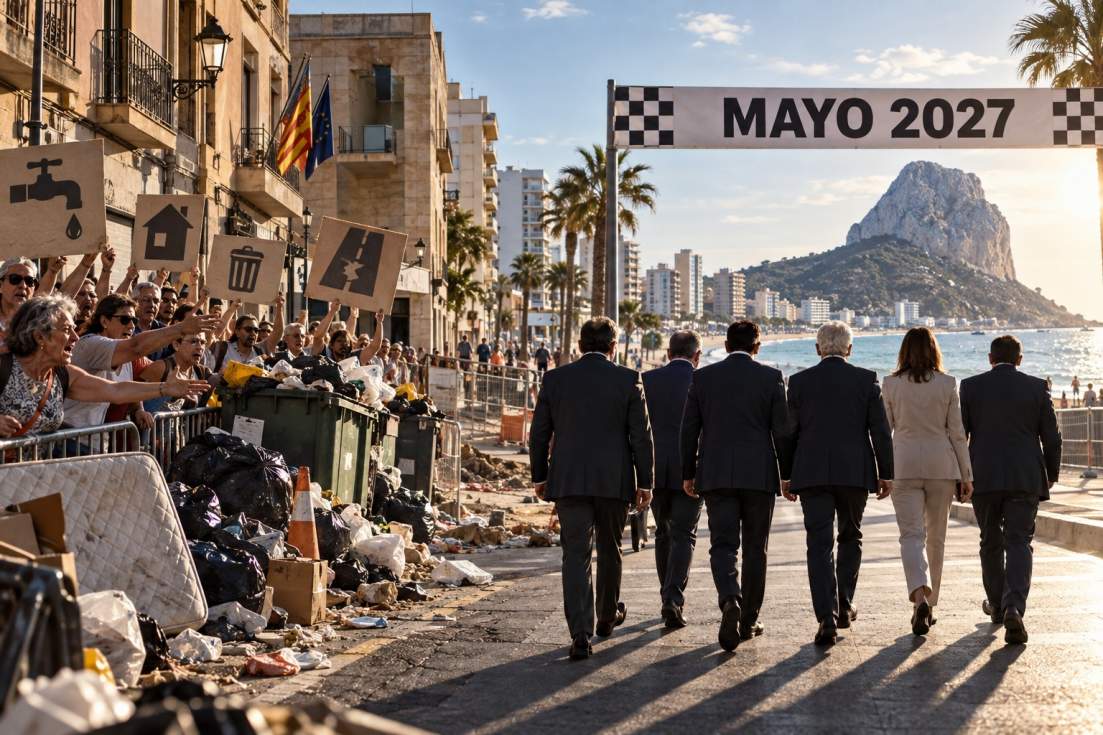
Neighbour,
I left thinking I needed to rest.
And that was true.
But distance does more than help you rest. It helps you see what was impossible to see when every Monday came too close to the one before.
For months, we talked about taxes, housing, parking, grants, tradition, work, waste, politics.
Different issues.
Different weeks.
Different problems.
Or so it seemed.
Because when the noise dies down and you look at the whole road behind you, a much more uncomfortable question begins to appear:
What if, for more than a year, we had been looking at the same problem from different angles?
That is why Black Mondays is back.
Not to pick up where we left off.
To look from higher up.
Distance leaves behind a rather uncomfortable conclusion.
The problem was never just the tax. Nor the blue parking zone. Nor housing. Nor waste. Nor a grant. Nor a festival. Nor an ordinance that decides when working starts to become a nuisance.
The problem appears when you put the pieces together.
Then you see an extraordinarily efficient system for telling you how much you must pay, what you may do, what time you may do it, where you may park, which form you must fill in, which public authority is responsible and why the solution always seems to depend on the next administrative step.
And standing opposite it, the same figure always appears.
You.
Paying.
Waiting.
Adapting.
For a year, we described mistakes, delays and decisions. We also pointed out that there was a method. Distance does not erase that work: it allows us to see its reach more clearly.
Perhaps we were describing something bigger.
Perhaps we were describing the system.
This week there was an extraordinary council meeting. Two main issues were on the table: career progression for municipal employees and the Town Hall’s commitment regarding the proposed site for the future health centre.
On that second issue, what was being discussed was a necessary step for the administrative process to continue before the health authorities.
And there we watched the system do what it does so well when a need takes too long to be resolved:
explain itself.
Some recalled what the previous government had failed to do.
Others recalled what the government before that had failed to do.
Some pointed to Marina Salud.
Others to the Generalitat.
Some defended their years in office.
Others used those years as a reproach.
There was talk of contracts, responsibilities, parties, education and ambulances. At one point, someone even had to ask that it stop looking like a political rally.
And while the system argued with itself, there was one thing on which everyone seemed to agree:
Calp needs another health centre.
So much so that, in the end, everyone voted in favour.
That is the paradox.
The need unites.
Responsibility is divided.
The waiting remains.
And this is where the story begins to become uncomfortable for any narrative that is too simple.
Because Calp’s healthcare need did not begin with this government.
Nor with the one before it.
During the concession, a healthcare initiative had already been committed for Calp. The Town Hall itself recalled in 2024, when that model came to an end, that it was still awaiting implementation.
In the meantime, regional governments of different political colours had come and gone.
This is not about simply equating that commitment with the current project. It is about remembering that the history of this need did not begin with the latest administrative file.
That does not mean everyone did the same thing.
Nor that everyone bears the same responsibility.
It means something much harder to explain:
the need outlived them all.
And if there was a contract, a concession-granting authority and mechanisms of oversight, then the question can no longer be only who made the promise.
We must also ask who monitored it, what was demanded when it was not fulfilled, and what happened to the outstanding obligations when the concession ended.
Not to distribute the same blame among everyone.
To understand what each one was responsible for.
And it would be unfair to say that nothing happened this week.
Something did.
The administrative step before the Generalitat has been taken: assuming responsibility for the electricity, water, sewerage and telephone connections, together with the works needed to prepare the plot so that the health authorities can assess the site for the second health centre.
That is progress.
Because holding power to account does not mean denying what is being done.
It also means calling it by its proper name.
But there is one expression worth reading slowly:
“The final administrative step.”
Because it is the final municipal administrative step in this phase.
Not the final step towards the health centre.
The plot still has to be deemed suitable. After that, the project, the funding and the construction itself will have to be defined. During the council meeting, there was also a call for the necessary budget allocation to be included in the regional government’s 2027 budget.
Acknowledging the step that has been taken does not mean mistaking it for the destination.
That is the difference between administrative time and the resident’s time.
For the administrative process, a phase may be ending.
For someone waiting for a doctor, there is still a long way to go.
Meanwhile, children grow and parents grow old.
Life does not stop to wait for the administrative process.
In a few months, politics will once again do what it always does before an election:
look ahead.
It will talk about projects.
About teams.
About the future.
About everything that can still be done.
And it has every right to do so.
But the resident also has the right to look back.
To remember what they paid.
What they waited for.
What was promised.
What came to an end.
And what still remains trapped in an administrative file.
Because a democracy should not force its citizens to reset their memory every four years.
Before listening to the next promise, it is worth knowing what happened to the previous one.
Perhaps that will be one of the tasks of this third season:
to stop the electoral calendar from erasing the resident’s calendar.
Neighbour,
in July I left to rest.
Not to forget.
I return to acknowledge every step forward.
And to make sure that what remains pending does not disappear when the person telling the story changes.
The third season begins here.
The resident’s wait does not.
Black Mondays is back.
Once read,
it cannot be unread.
AVE CALPINVS.

Francisco Ramón Perona García (@fran_rpg)
Jurist. Citizen. Uncomfortable.
Neighbour,
I left thinking I needed to rest.
And that was true.
But distance does more than help you rest. It helps you see what was impossible to see when every Monday came too close to the one before.
For months, we talked about taxes, housing, parking, grants, tradition, work, waste, politics.
Different issues.
Different weeks.
Different problems.
Or so it seemed.
Because when the noise dies down and you look at the whole road behind you, a much more uncomfortable question begins to appear:
What if, for more than a year, we had been looking at the same problem from different angles?
That is why Black Mondays is back.
Not to pick up where we left off.
To look from higher up.
Distance leaves behind a rather uncomfortable conclusion.
The problem was never just the tax. Nor the blue parking zone. Nor housing. Nor waste. Nor a grant. Nor a festival. Nor an ordinance that decides when working starts to become a nuisance.
The problem appears when you put the pieces together.
Then you see an extraordinarily efficient system for telling you how much you must pay, what you may do, what time you may do it, where you may park, which form you must fill in, which public authority is responsible and why the solution always seems to depend on the next administrative step.
And standing opposite it, the same figure always appears.
You.
Paying.
Waiting.
Adapting.
For a year, we described mistakes, delays and decisions. We also pointed out that there was a method. Distance does not erase that work: it allows us to see its reach more clearly.
Perhaps we were describing something bigger.
Perhaps we were describing the system.
This week there was an extraordinary council meeting. Two main issues were on the table: career progression for municipal employees and the Town Hall’s commitment regarding the proposed site for the future health centre.
On that second issue, what was being discussed was a necessary step for the administrative process to continue before the health authorities.
And there we watched the system do what it does so well when a need takes too long to be resolved:
explain itself.
Some recalled what the previous government had failed to do.
Others recalled what the government before that had failed to do.
Some pointed to Marina Salud.
Others to the Generalitat.
Some defended their years in office.
Others used those years as a reproach.
There was talk of contracts, responsibilities, parties, education and ambulances. At one point, someone even had to ask that it stop looking like a political rally.
And while the system argued with itself, there was one thing on which everyone seemed to agree:
Calp needs another health centre.
So much so that, in the end, everyone voted in favour.
That is the paradox.
The need unites.
Responsibility is divided.
The waiting remains.
And this is where the story begins to become uncomfortable for any narrative that is too simple.
Because Calp’s healthcare need did not begin with this government.
Nor with the one before it.
During the concession, a healthcare initiative had already been committed for Calp. The Town Hall itself recalled in 2024, when that model came to an end, that it was still awaiting implementation.
In the meantime, regional governments of different political colours had come and gone.
This is not about simply equating that commitment with the current project. It is about remembering that the history of this need did not begin with the latest administrative file.
That does not mean everyone did the same thing.
Nor that everyone bears the same responsibility.
It means something much harder to explain:
the need outlived them all.
And if there was a contract, a concession-granting authority and mechanisms of oversight, then the question can no longer be only who made the promise.
We must also ask who monitored it, what was demanded when it was not fulfilled, and what happened to the outstanding obligations when the concession ended.
Not to distribute the same blame among everyone.
To understand what each one was responsible for.
And it would be unfair to say that nothing happened this week.
Something did.
The administrative step before the Generalitat has been taken: assuming responsibility for the electricity, water, sewerage and telephone connections, together with the works needed to prepare the plot so that the health authorities can assess the site for the second health centre.
That is progress.
Because holding power to account does not mean denying what is being done.
It also means calling it by its proper name.
But there is one expression worth reading slowly:
“The final administrative step.”
Because it is the final municipal administrative step in this phase.
Not the final step towards the health centre.
The plot still has to be deemed suitable. After that, the project, the funding and the construction itself will have to be defined. During the council meeting, there was also a call for the necessary budget allocation to be included in the regional government’s 2027 budget.
Acknowledging the step that has been taken does not mean mistaking it for the destination.
That is the difference between administrative time and the resident’s time.
For the administrative process, a phase may be ending.
For someone waiting for a doctor, there is still a long way to go.
Meanwhile, children grow and parents grow old.
Life does not stop to wait for the administrative process.
In a few months, politics will once again do what it always does before an election:
look ahead.
It will talk about projects.
About teams.
About the future.
About everything that can still be done.
And it has every right to do so.
But the resident also has the right to look back.
To remember what they paid.
What they waited for.
What was promised.
What came to an end.
And what still remains trapped in an administrative file.
Because a democracy should not force its citizens to reset their memory every four years.
Before listening to the next promise, it is worth knowing what happened to the previous one.
Perhaps that will be one of the tasks of this third season:
to stop the electoral calendar from erasing the resident’s calendar.
Neighbour,
in July I left to rest.
Not to forget.
I return to acknowledge every step forward.
And to make sure that what remains pending does not disappear when the person telling the story changes.
The third season begins here.
The resident’s wait does not.
Black Mondays is back.
Once read,
it cannot be unread.
AVE CALPINVS.
Francisco Ramón Perona García (@fran_rpg)
Jurist. Citizen. Uncomfortable.




Normas de participación
Esta es la opinión de los lectores, no la de este medio.
Nos reservamos el derecho a eliminar los comentarios inapropiados.
La participación implica que ha leído y acepta las Normas de Participación y Política de Privacidad
Normas de Participación
Política de privacidad
Por seguridad guardamos tu IP
18.97.9.173