

Opinion piece from Calp – 'Los lunes negros' column
Neighbour. The national team unites. Politics divides up the screen.
Or how the World Cup filled Calp with joy while power decided where people looked, where they spent, and who was left out.
Neighbour,
the national team did in one night what local politics has not managed in years.
It brought Calp together.
It brought together the person who lives in the centre, the one who lives in La Fossa, the one who works in the port, the one who opens a business, the one who serves tables, the one who only wanted to watch the match and the one who, for a few hours, preferred to put the quarrel aside.
Spain put something clean on the table.
Joy.
Pride.
An excuse to look together.
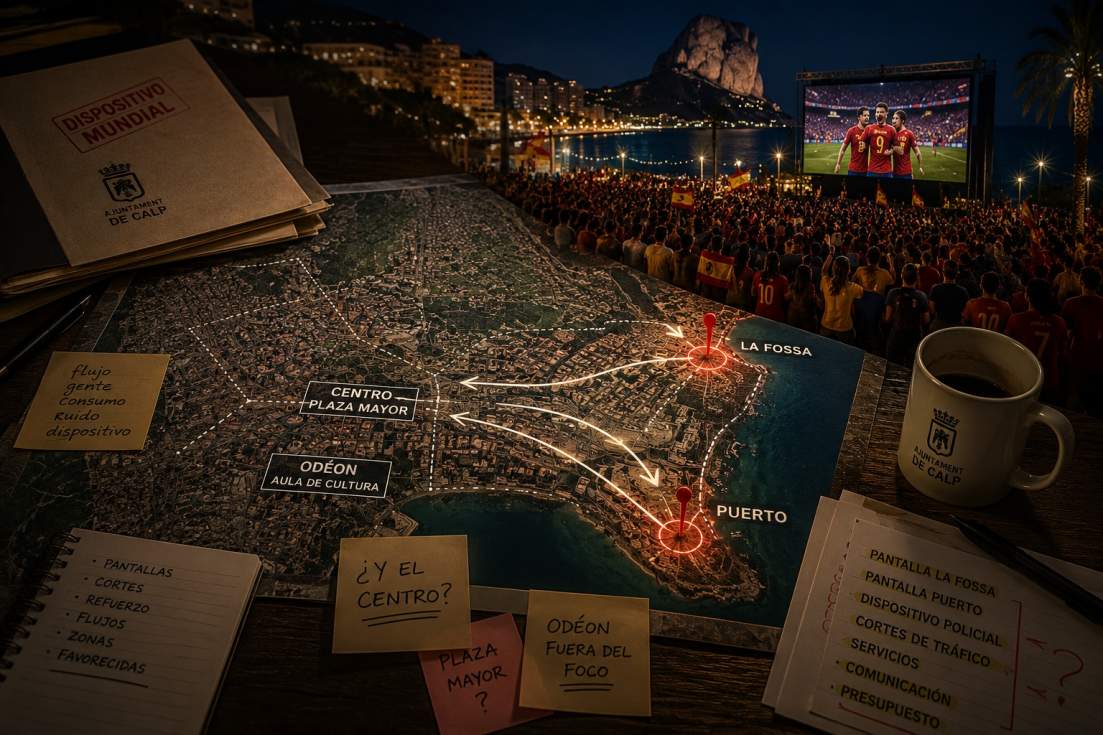
And precisely for that reason, it is worth looking at what politics did with that joy when it had to turn it into a map, screens and a public setup.
Let no one play the easy trick.
This is not about turning off the screen.
It is not about taking anyone’s flag away.
It is not about spoiling the final for a town that had the right to celebrate.
It is about something else.
It is about looking at what happens when power takes a clean emotion and turns it into a public setup.
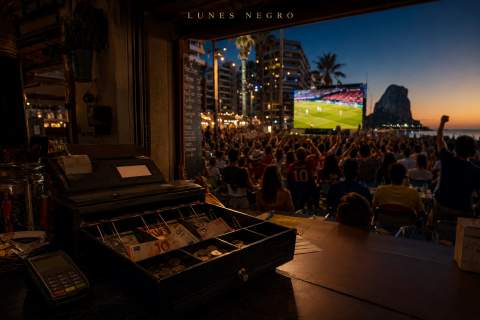
A screen here.
Another there.
Traffic cut here.
Silence there.
People here.
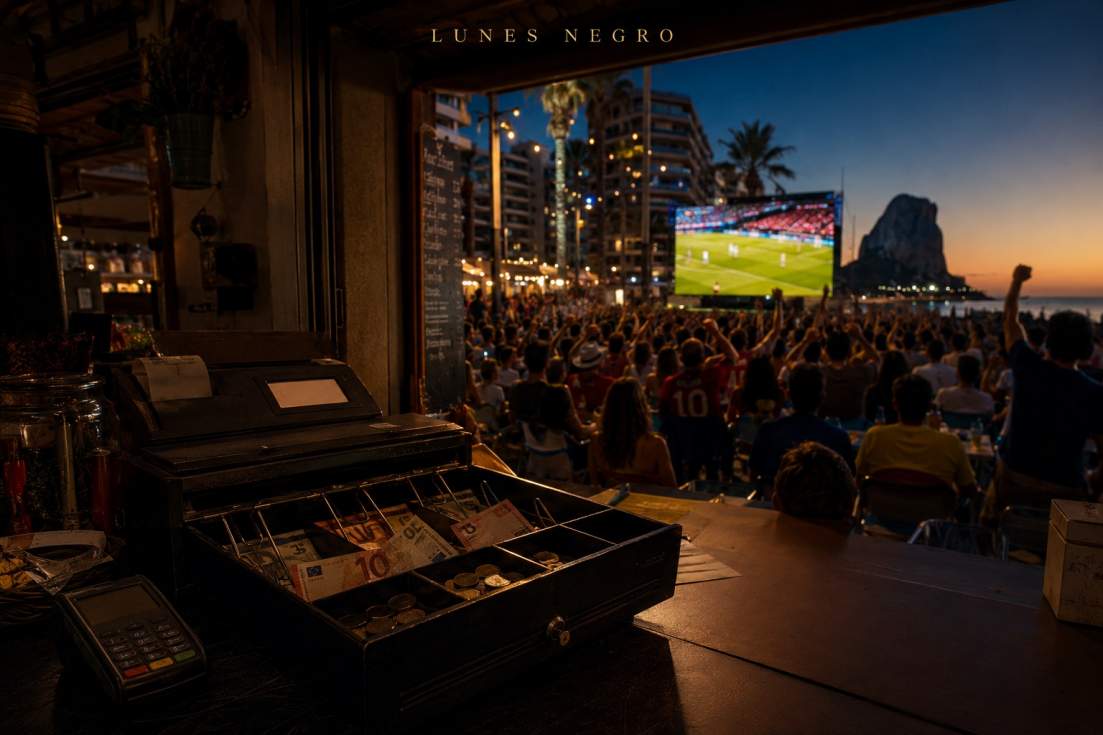
A business there, watching the night pass it by.
That is the point.
The joy belonged to everyone.
The screen did not.
The joy had no owner.
The screen did have a location.
And in local politics, location is never neutral.
Because a screen does not only show a match.
It organises where people look.
It moves people.
It moves consumption.
It moves noise.
It activates the machinery.
It cuts streets.
It produces photographs.
It redirects spending.
It moves the feeling of which part of Calp lives the night from within and which part is left watching from outside. Because every map, however technical it may seem, also says who is inside and who is left out.
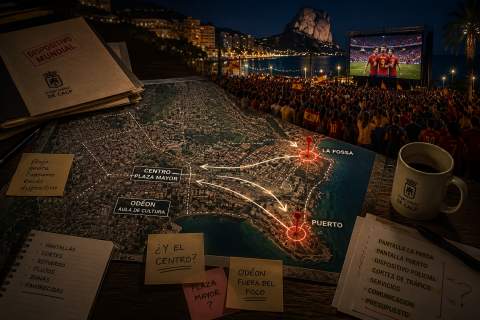
The map was not an anecdote.
It was the message.
La Fossa had a screen.
The Port had a screen.
The centre had questions.
Plaza Mayor had silence.
The Odéon amphitheatre watched from outside.
And some businesses immediately understood what is sometimes so hard to explain in a council meeting: that a public decision does not only organise a night.
It organises the flow.
It organises the photograph.
It organises who receives people.
It organises who receives noise.
It organises who receives consumption.
And it also organises who is left watching joy pass down another street.
Because there are absences that also illuminate.
And it is worth saying it clearly.
The person who asks is not always being a nuisance.
Sometimes he is pointing to the gap.
The person who asked about the centre was not against Spain.
The person who asked about the Odéon was not against the final.
The person who looked at his empty business was not against joy.
He was saying something simpler and more uncomfortable:
I am Calp too.
My street is Calp too.
My business also pays for Calp.
My square also sustains Calp.
My night also had the right to exist.
Because when a town truly celebrates, there should not be neighbours in front of the screen and neighbours left in the back row.
That is why the meaning of the week was not only on the screen.
It was underneath.
In the comments.
In the businesses.
In those asking about the centre.
In those who shared it.
In those bringing it into conversations where politics does not normally enter.
In those who understood that this reading was no coincidence.
People did not read it because they were against Spain.
They read because they had understood something.
That a screen can show a match.
But it can also show the distribution.
The screen does not cover the question.
Sometimes it lights it up.
And when it lights it up, it also leaves visible what some would rather keep out of frame.
Neighbour,
there are joys that last one night.
And maps that explain a town.
The final will pass.
The result will pass.
The photograph will pass.
But the usual question will remain: who decides where Calp is allowed to happen.
Because a town is not divided when it celebrates.
It is divided when one part celebrates inside the spotlight and another learns, once again, to watch from the edge.
Spain made Calp look in the same direction.
Politics decided from where.
The national team unites.
Politics divides up the screen.
Once read,
it cannot be unread.
AVE CALPINVS.

Francisco Ramón Perona García (@fran_rpg)
Jurist. Citizen. Uncomfortable.

Neighbour,
the national team did in one night what local politics has not managed in years.
It brought Calp together.
It brought together the person who lives in the centre, the one who lives in La Fossa, the one who works in the port, the one who opens a business, the one who serves tables, the one who only wanted to watch the match and the one who, for a few hours, preferred to put the quarrel aside.
Spain put something clean on the table.
Joy.
Pride.
An excuse to look together.
And precisely for that reason, it is worth looking at what politics did with that joy when it had to turn it into a map, screens and a public setup.
Let no one play the easy trick.
This is not about turning off the screen.
It is not about taking anyone’s flag away.
It is not about spoiling the final for a town that had the right to celebrate.
It is about something else.
It is about looking at what happens when power takes a clean emotion and turns it into a public setup.
A screen here.
Another there.
Traffic cut here.
Silence there.
People here.
A business there, watching the night pass it by.
That is the point.
The joy belonged to everyone.
The screen did not.
The joy had no owner.
The screen did have a location.
And in local politics, location is never neutral.
Because a screen does not only show a match.
It organises where people look.
It moves people.
It moves consumption.
It moves noise.
It activates the machinery.
It cuts streets.
It produces photographs.
It redirects spending.
It moves the feeling of which part of Calp lives the night from within and which part is left watching from outside. Because every map, however technical it may seem, also says who is inside and who is left out.
The map was not an anecdote.
It was the message.
La Fossa had a screen.
The Port had a screen.
The centre had questions.
Plaza Mayor had silence.
The Odéon amphitheatre watched from outside.
And some businesses immediately understood what is sometimes so hard to explain in a council meeting: that a public decision does not only organise a night.
It organises the flow.
It organises the photograph.
It organises who receives people.
It organises who receives noise.
It organises who receives consumption.
And it also organises who is left watching joy pass down another street.
Because there are absences that also illuminate.
And it is worth saying it clearly.
The person who asks is not always being a nuisance.
Sometimes he is pointing to the gap.
The person who asked about the centre was not against Spain.
The person who asked about the Odéon was not against the final.
The person who looked at his empty business was not against joy.
He was saying something simpler and more uncomfortable:
I am Calp too.
My street is Calp too.
My business also pays for Calp.
My square also sustains Calp.
My night also had the right to exist.
Because when a town truly celebrates, there should not be neighbours in front of the screen and neighbours left in the back row.
That is why the meaning of the week was not only on the screen.
It was underneath.
In the comments.
In the businesses.
In those asking about the centre.
In those who shared it.
In those bringing it into conversations where politics does not normally enter.
In those who understood that this reading was no coincidence.
People did not read it because they were against Spain.
They read because they had understood something.
That a screen can show a match.
But it can also show the distribution.
The screen does not cover the question.
Sometimes it lights it up.
And when it lights it up, it also leaves visible what some would rather keep out of frame.
Neighbour,
there are joys that last one night.
And maps that explain a town.
The final will pass.
The result will pass.
The photograph will pass.
But the usual question will remain: who decides where Calp is allowed to happen.
Because a town is not divided when it celebrates.
It is divided when one part celebrates inside the spotlight and another learns, once again, to watch from the edge.
Spain made Calp look in the same direction.
Politics decided from where.
The national team unites.
Politics divides up the screen.
Once read,
it cannot be unread.
AVE CALPINVS.
Francisco Ramón Perona García (@fran_rpg)
Jurist. Citizen. Uncomfortable.











Normas de participación
Esta es la opinión de los lectores, no la de este medio.
Nos reservamos el derecho a eliminar los comentarios inapropiados.
La participación implica que ha leído y acepta las Normas de Participación y Política de Privacidad
Normas de Participación
Política de privacidad
Por seguridad guardamos tu IP
216.73.216.28