

Opinion piece from Calp – 'Los lunes negros' column
Neighbour. The fire changed hands.
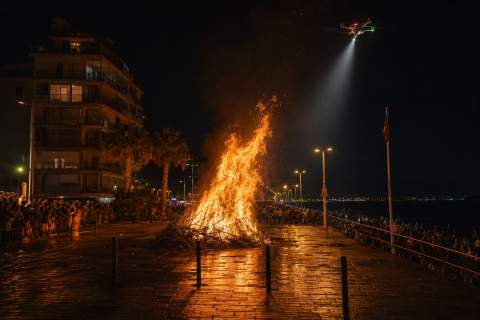
Or how a popular tradition ended up turned into a poster, a drone and surveillance.
Neighbour,
there are traditions you do not learn by reading a poster.
You learn them with the body.
With the heat on your face. With the sand under your feet. With the clumsy jump of a child who looks at the bonfire and feels, for the first time, that the night belongs to everyone. San Juan was that: a small act of communal belonging around the fire. Not perfect. Not clean. Not free of risk. But alive.
Now the fire has not disappeared.
It has simply been moved away from the resident.
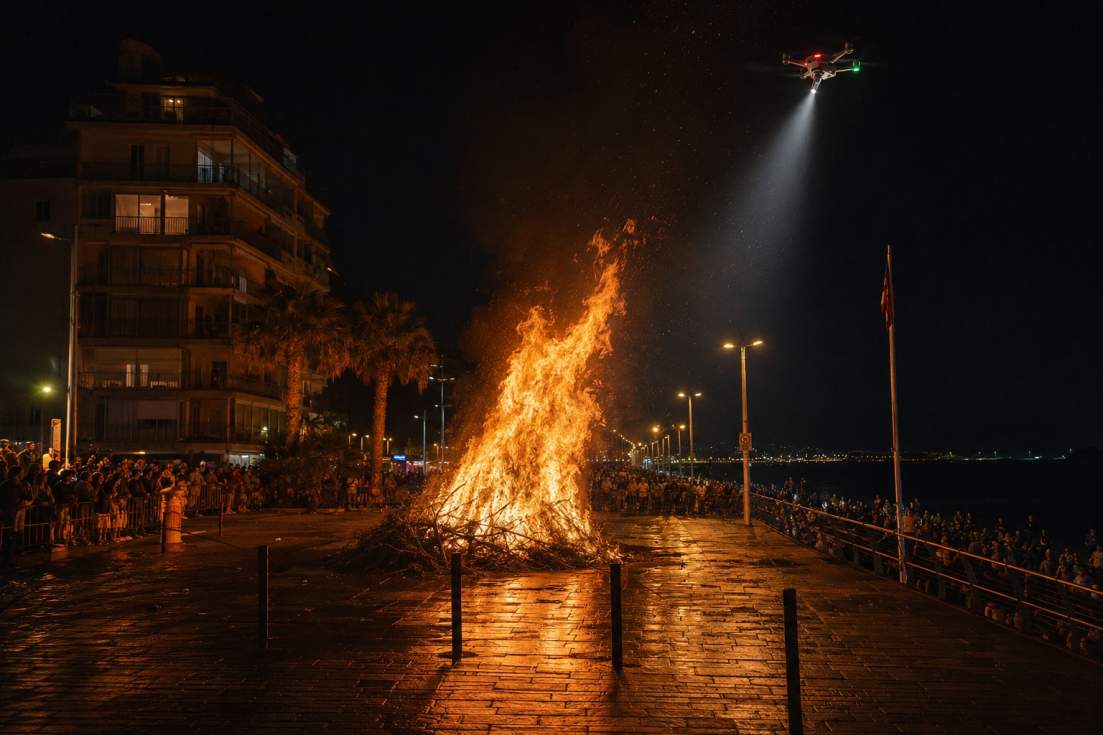
Behind a fence, a ban, a drone and a screen.
The fire was not just fire.
It was the centre.
It was a call.
It was an ancient way of gathering, together, without asking for too many explanations.
That is why it hurts more to see it turned into a managed object: lit by some, watched by others, monitored from above and later narrated as if nothing essential had been lost.
The fire changed hands.
And with it, the night changed too.
The sequence was perfect.
First, the resident’s fire was banned.
Then the permitted fire was lit.
Then the fence went up.
Then the drone flew.
Then the screen appeared.
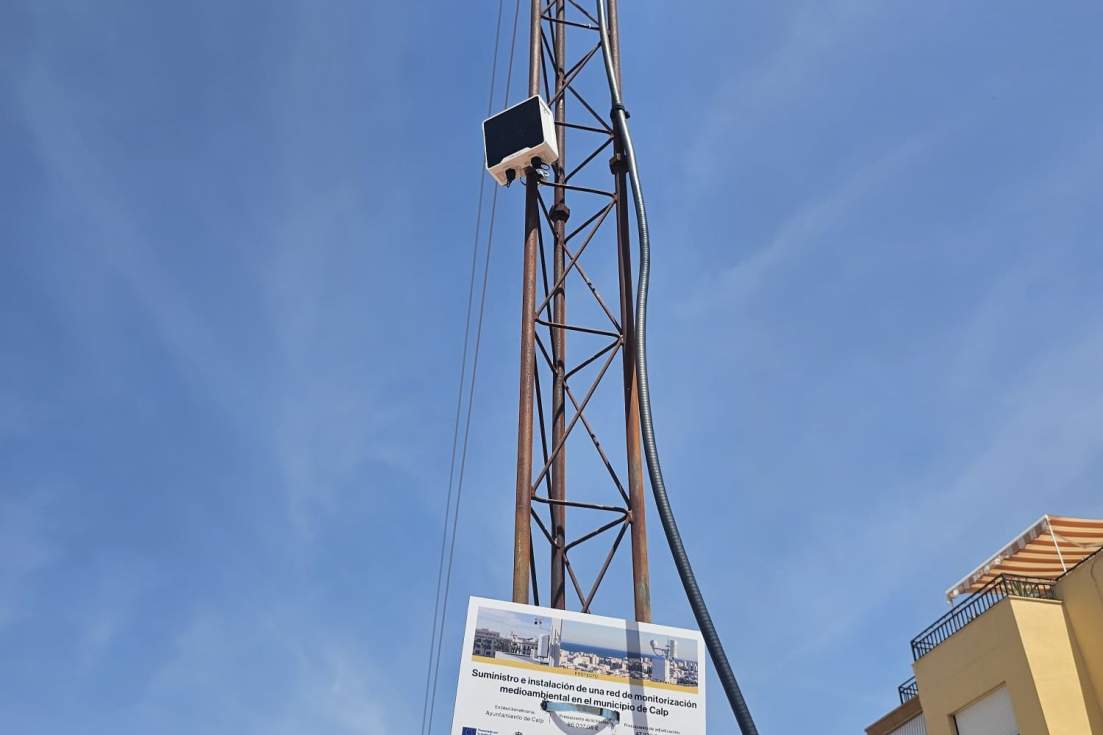
And, almost at the same time, another layer was announced: thirty new cameras, one hundred and fifty thousand euros, number-plate recognition, a control centre and surveillance at strategic points.
It is not just San Juan.
No one disputes that a town must organise a complicated night. What is disputed is when organising begins to replace living.
It is a way of governing: remove the spontaneous, replace it with a device, and call it safety.
The problem is not the rule.
The problem is the soul that is lost when the rule takes the place of custom.
The problem is not preventing risk, but prevention ending up replacing the rite.
The problem is not one camera.
The problem is a town that begins to accept that everything must be watched from above in order to keep functioning below.
Because when trust disappears, power always finds a noble word to cover the gap.
Sometimes it calls it safety.
Sometimes coexistence.
Sometimes modernisation.
But the gap remains.
That is the trap.
To sell Calp, everything is an experience.
To live Calp, everything is an instruction.
To govern it, more and more screens.
Calp is sold as summer freedom, but administered like a controlled space.
It is sold as an open postcard, but lived between signs.
It is announced as a fiesta, but organised like an operation.
Coexistence is invoked, but suspicion is the starting point.
And in the end, the resident understands the message: the town is beautiful to look at, profitable to sell and dangerous to let live without supervision.
The fire was dangerous, yes. But so is a town that only knows how to protect what it once knew how to share.
The most serious thing is not that one night changes.
The most serious thing is that the memory left by that night changes.
The cost is not paid only by today’s resident.
It will also be paid by the children who grow up believing that San Juan was always this: a night of fences, orders, cameras, drones and distant fire.
They will not know what it was to approach with fear and laughter.
They will not know what it was to jump.
They will not know what it was to feel that the beach, for one night, was not a managed space but a place held in common.
And when one generation stops living a tradition, the next does not lose it.
It simply never knows it.
San Juan may keep its name.
But it will have lost its transmission.
Neighbour,
perhaps one day a child will ask what San Juan was.
And someone will tell him that it was a night of fire, of sand, of jumps, of small fear and of people gathered around a bonfire.
But if that child has only known fences, drones, screens and bans, he will not be hearing a tradition.
He will be hearing a loss.
Because traditions do not always die all at once.
Sometimes they keep the name.
Sometimes they keep the photograph.
Sometimes they even keep a fire burning behind a fence.
But they die when they stop belonging to those who lived them.
And when a tradition stops belonging to the resident, lighting a flame is no longer enough to say that it is still alive.
The fire did not disappear.
It changed hands.
And a town that stops trusting its people may be very controlled.
But not necessarily better governed.
Once read,
it cannot be unread.
AVE CALPINVS.

Francisco Ramón Perona García (@fran_rpg)
Jurist. Citizen. Uncomfortable.

Neighbour,
there are traditions you do not learn by reading a poster.
You learn them with the body.
With the heat on your face. With the sand under your feet. With the clumsy jump of a child who looks at the bonfire and feels, for the first time, that the night belongs to everyone. San Juan was that: a small act of communal belonging around the fire. Not perfect. Not clean. Not free of risk. But alive.
Now the fire has not disappeared.
It has simply been moved away from the resident.
Behind a fence, a ban, a drone and a screen.
The fire was not just fire.
It was the centre.
It was a call.
It was an ancient way of gathering, together, without asking for too many explanations.
That is why it hurts more to see it turned into a managed object: lit by some, watched by others, monitored from above and later narrated as if nothing essential had been lost.
The fire changed hands.
And with it, the night changed too.
The sequence was perfect.
First, the resident’s fire was banned.
Then the permitted fire was lit.
Then the fence went up.
Then the drone flew.
Then the screen appeared.
And, almost at the same time, another layer was announced: thirty new cameras, one hundred and fifty thousand euros, number-plate recognition, a control centre and surveillance at strategic points.
It is not just San Juan.
No one disputes that a town must organise a complicated night. What is disputed is when organising begins to replace living.
It is a way of governing: remove the spontaneous, replace it with a device, and call it safety.
The problem is not the rule.
The problem is the soul that is lost when the rule takes the place of custom.
The problem is not preventing risk, but prevention ending up replacing the rite.
The problem is not one camera.
The problem is a town that begins to accept that everything must be watched from above in order to keep functioning below.
Because when trust disappears, power always finds a noble word to cover the gap.
Sometimes it calls it safety.
Sometimes coexistence.
Sometimes modernisation.
But the gap remains.
That is the trap.
To sell Calp, everything is an experience.
To live Calp, everything is an instruction.
To govern it, more and more screens.
Calp is sold as summer freedom, but administered like a controlled space.
It is sold as an open postcard, but lived between signs.
It is announced as a fiesta, but organised like an operation.
Coexistence is invoked, but suspicion is the starting point.
And in the end, the resident understands the message: the town is beautiful to look at, profitable to sell and dangerous to let live without supervision.
The fire was dangerous, yes. But so is a town that only knows how to protect what it once knew how to share.
The most serious thing is not that one night changes.
The most serious thing is that the memory left by that night changes.
The cost is not paid only by today’s resident.
It will also be paid by the children who grow up believing that San Juan was always this: a night of fences, orders, cameras, drones and distant fire.
They will not know what it was to approach with fear and laughter.
They will not know what it was to jump.
They will not know what it was to feel that the beach, for one night, was not a managed space but a place held in common.
And when one generation stops living a tradition, the next does not lose it.
It simply never knows it.
San Juan may keep its name.
But it will have lost its transmission.
Neighbour,
perhaps one day a child will ask what San Juan was.
And someone will tell him that it was a night of fire, of sand, of jumps, of small fear and of people gathered around a bonfire.
But if that child has only known fences, drones, screens and bans, he will not be hearing a tradition.
He will be hearing a loss.
Because traditions do not always die all at once.
Sometimes they keep the name.
Sometimes they keep the photograph.
Sometimes they even keep a fire burning behind a fence.
But they die when they stop belonging to those who lived them.
And when a tradition stops belonging to the resident, lighting a flame is no longer enough to say that it is still alive.
The fire did not disappear.
It changed hands.
And a town that stops trusting its people may be very controlled.
But not necessarily better governed.
Once read,
it cannot be unread.
AVE CALPINVS.
Francisco Ramón Perona García (@fran_rpg)
Jurist. Citizen. Uncomfortable.














Normas de participación
Esta es la opinión de los lectores, no la de este medio.
Nos reservamos el derecho a eliminar los comentarios inapropiados.
La participación implica que ha leído y acepta las Normas de Participación y Política de Privacidad
Normas de Participación
Política de privacidad
Por seguridad guardamos tu IP
216.73.216.230