

Opinion piece from Calp – 'Los lunes negros' column
Neighbour. The year when no one will be able to pretend anymore.
Or how a town begins to lose its innocence when the scenery no longer hides the crack.
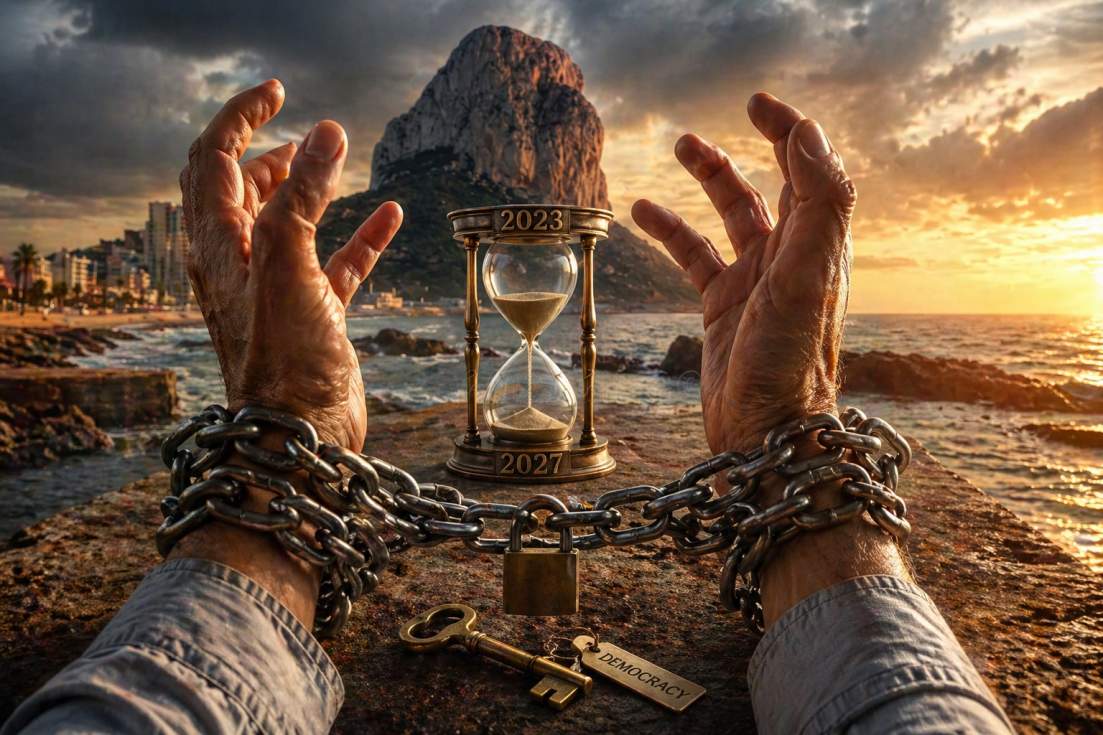
Neighbour.
Not all endings begin with a bang.
Some begin with something subtler.
Slower.
More revealing.
They begin when a town enters that year — the last one before the elections — in which power is still standing, but no longer carries the same truth.
It still occupies the place.
It still speaks.
It still poses.
It still responds.
But it no longer shapes time: it endures it.
And once that year begins, something else begins too.
Calculation begins.
Maneuver begins.
The gesture that no longer seeks to govern, but to arrive.
And then every movement changes its nature.
A photograph is no longer just a photograph.
An explanation is no longer just an explanation.
A disagreement is no longer just a disagreement.
Everything begins to sound like a symptom.
Everything begins to weigh like a sign.
Calp has entered that year.
The year in which each person begins, whether they want to or not, to show who they are.
And that is what makes this week so important.
Not because one single extraordinary thing has happened.
Not because everything has suddenly exploded.
But because, one year before the elections, the facts no longer appear in isolation.
They begin to fit together.
A late reaction no longer seems like just a late reaction.
A minor publication no longer seems like just a minor publication.
A correction no longer sounds like prudence.
A pose of strength no longer sounds like command.
Everything begins to reveal something else:
who is trying to hold on,
who is trying to reposition themselves,
who is trying to fake normality,
and who is beginning to understand that the scenery no longer hides things in the same way.
That is why this week must not be read as a sum of episodes.
It must be read as a phase of revelation.
Because when the facts begin to fit together,
power stops seeming complex
and begins, quite simply, to be seen.
No great fireworks have been needed.
A sequence has been enough.
First, the blow.
A column that breaks the old modesty of silence and leaves the system without a reply worthy of the moment.
Then, the silence.
The uncomfortable observation.
The empty publication.
The opposition article that tries to exist, but carries no weight.
The feeling that no one dares go to the heart of the matter, because doing so would mean accepting the frame.
And then, just when the apparatus tries to recover its composure, the inner truth appears:
the dismissal,
the wound,
the forced explanation,
the piece that falls,
the old guard sharpening its knives,
and the government that, instead of rebuilding authority, devotes itself to managing damage.
That has been the week.
A succession of scenes in which power has tried to keep looking whole while the stitching was becoming far too visible.
And there the deeper accusation appears.
Calp’s problem is no longer only that some decisions arrive late, others are patched up, and others are poorly explained.
The problem is another one:
power is beginning to care more about preserving form than about sustaining direction.
You can see it when a legislature no longer conveys command, but endurance.
When initiative gives way to reaction.
When the explanation arrives before the solution.
When institutional presence multiplies, but authority shrinks.
At that point, government no longer works from a visible conviction.
It works from a need:
the need to keep seeming like government when it is already beginning to struggle to be one.
And that has a very serious consequence.
Each gesture stops being perceived as service
and begins to be perceived as the administration of deterioration.
And there the great paradox of this time appears.
The more power needs to seem stable, the more its wear becomes visible.
The more it tries to project normality, the more the crack can be seen.
The more it tries to preserve command, the more it begins to reveal that it no longer governs with the same firmness.
But the paradox does not end there.
Because while power reveals itself, the neighbour changes too.
Not because control has already been regained.
Not because the course can already be corrected.
But because the neighbour begins to look differently.
People begin to comment more.
To remain silent less.
To connect facts they once saw separately.
To distrust the small thing when it appears precisely to cover up the larger one.
And so, while power keeps trying to pretend, the town begins to lose its innocence.
And while they reposition themselves, watch one another, measure one another and reveal themselves,
the neighbour remains trapped.
That is the obscenity.
Power enters a phase of calculation
while the citizen remains in a phase of burden.
A fiscal burden.
An urban burden.
A housing burden.
A moral burden.
One year of the legislature still remains.
A whole year of continuing to live inside a local system that has already begun to reveal itself,
but still retains the power to decide over people’s time, their street, their patience and their town.
Because the people of Calp are beginning to understand something harsh:
they were not only badly served.
They were also captive.
And when a neighbour discovers that they remain hostage to the exhausted mandate that administers them,
they never look at politics in quite the same way again.
Neighbour.
What matters is not that power has already changed.
What matters is that the way people look at it has begun to change.
And when a town begins to look without naivety,
without fear,
and without the old reflex of swallowing the scenery whole,
something breaks forever.
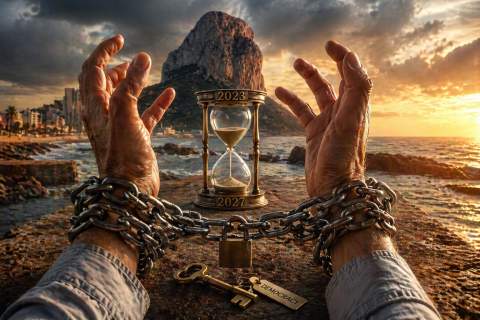
There is still one year left until 2027.
A long year.
A year of maneuvers, calculations, and attempts to seem like what one no longer is.
But it will also be the year in which each person begins to leave their moral footprint in plain sight.
Because a moment comes when no one needs to unmask themselves anymore.
They simply need to act.
And Calp has already entered that time.
The time when no one will be able to pretend anymore.
Once read,
it cannot be unread.
AVE CALPINVS.

Francisco Ramón Perona García (@fran_rpg)
Jurist. Citizen. Uncomfortable.

Neighbour.
Not all endings begin with a bang.
Some begin with something subtler.
Slower.
More revealing.
They begin when a town enters that year — the last one before the elections — in which power is still standing, but no longer carries the same truth.
It still occupies the place.
It still speaks.
It still poses.
It still responds.
But it no longer shapes time: it endures it.
And once that year begins, something else begins too.
Calculation begins.
Maneuver begins.
The gesture that no longer seeks to govern, but to arrive.
And then every movement changes its nature.
A photograph is no longer just a photograph.
An explanation is no longer just an explanation.
A disagreement is no longer just a disagreement.
Everything begins to sound like a symptom.
Everything begins to weigh like a sign.
Calp has entered that year.
The year in which each person begins, whether they want to or not, to show who they are.
And that is what makes this week so important.
Not because one single extraordinary thing has happened.
Not because everything has suddenly exploded.
But because, one year before the elections, the facts no longer appear in isolation.
They begin to fit together.
A late reaction no longer seems like just a late reaction.
A minor publication no longer seems like just a minor publication.
A correction no longer sounds like prudence.
A pose of strength no longer sounds like command.
Everything begins to reveal something else:
who is trying to hold on,
who is trying to reposition themselves,
who is trying to fake normality,
and who is beginning to understand that the scenery no longer hides things in the same way.
That is why this week must not be read as a sum of episodes.
It must be read as a phase of revelation.
Because when the facts begin to fit together,
power stops seeming complex
and begins, quite simply, to be seen.
No great fireworks have been needed.
A sequence has been enough.
First, the blow.
A column that breaks the old modesty of silence and leaves the system without a reply worthy of the moment.
Then, the silence.
The uncomfortable observation.
The empty publication.
The opposition article that tries to exist, but carries no weight.
The feeling that no one dares go to the heart of the matter, because doing so would mean accepting the frame.
And then, just when the apparatus tries to recover its composure, the inner truth appears:
the dismissal,
the wound,
the forced explanation,
the piece that falls,
the old guard sharpening its knives,
and the government that, instead of rebuilding authority, devotes itself to managing damage.
That has been the week.
A succession of scenes in which power has tried to keep looking whole while the stitching was becoming far too visible.
And there the deeper accusation appears.
Calp’s problem is no longer only that some decisions arrive late, others are patched up, and others are poorly explained.
The problem is another one:
power is beginning to care more about preserving form than about sustaining direction.
You can see it when a legislature no longer conveys command, but endurance.
When initiative gives way to reaction.
When the explanation arrives before the solution.
When institutional presence multiplies, but authority shrinks.
At that point, government no longer works from a visible conviction.
It works from a need:
the need to keep seeming like government when it is already beginning to struggle to be one.
And that has a very serious consequence.
Each gesture stops being perceived as service
and begins to be perceived as the administration of deterioration.
And there the great paradox of this time appears.
The more power needs to seem stable, the more its wear becomes visible.
The more it tries to project normality, the more the crack can be seen.
The more it tries to preserve command, the more it begins to reveal that it no longer governs with the same firmness.
But the paradox does not end there.
Because while power reveals itself, the neighbour changes too.
Not because control has already been regained.
Not because the course can already be corrected.
But because the neighbour begins to look differently.
People begin to comment more.
To remain silent less.
To connect facts they once saw separately.
To distrust the small thing when it appears precisely to cover up the larger one.
And so, while power keeps trying to pretend, the town begins to lose its innocence.
And while they reposition themselves, watch one another, measure one another and reveal themselves,
the neighbour remains trapped.
That is the obscenity.
Power enters a phase of calculation
while the citizen remains in a phase of burden.
A fiscal burden.
An urban burden.
A housing burden.
A moral burden.
One year of the legislature still remains.
A whole year of continuing to live inside a local system that has already begun to reveal itself,
but still retains the power to decide over people’s time, their street, their patience and their town.
Because the people of Calp are beginning to understand something harsh:
they were not only badly served.
They were also captive.
And when a neighbour discovers that they remain hostage to the exhausted mandate that administers them,
they never look at politics in quite the same way again.
Neighbour.
What matters is not that power has already changed.
What matters is that the way people look at it has begun to change.
And when a town begins to look without naivety,
without fear,
and without the old reflex of swallowing the scenery whole,
something breaks forever.
There is still one year left until 2027.
A long year.
A year of maneuvers, calculations, and attempts to seem like what one no longer is.
But it will also be the year in which each person begins to leave their moral footprint in plain sight.
Because a moment comes when no one needs to unmask themselves anymore.
They simply need to act.
And Calp has already entered that time.
The time when no one will be able to pretend anymore.
Once read,
it cannot be unread.
AVE CALPINVS.
Francisco Ramón Perona García (@fran_rpg)
Jurist. Citizen. Uncomfortable.


















Normas de participación
Esta es la opinión de los lectores, no la de este medio.
Nos reservamos el derecho a eliminar los comentarios inapropiados.
La participación implica que ha leído y acepta las Normas de Participación y Política de Privacidad
Normas de Participación
Política de privacidad
Por seguridad guardamos tu IP
216.73.216.195