

Opinion piece from Calp – 'Los lunes negros' column
Neighbor. The people honour. Power poses.
Or how the people uphold what is essential… while power manages the scene.
Neighbor,
there are things in a town that do not depend on power.
They are not born in an office.
They are not scheduled by a council department.
They are not sustained by a press release.
Nor by an official in the front row.
They remain alive for another reason.
Because a people do not put them on display: they carry them within.
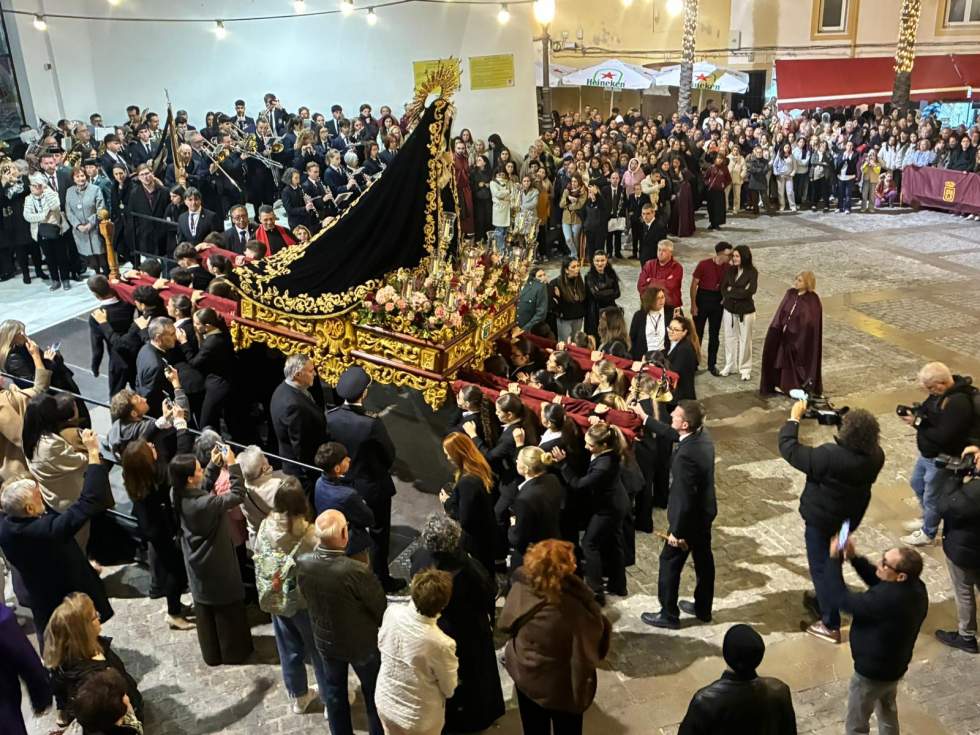
Calp’s Holy Week is not upheld by those who arrive when everything is already prepared.
It is upheld by those who are there beforehand.
Those who carry.
Those who rehearse.
Those who sew.
Those who accompany.
Those who keep silent.
Those who repeat an inherited gesture without turning it into a showcase.
That is why, this week, it is worth beginning where power almost never begins:
not with the photograph,
not with the representation,
not with ceremonial presence,
but with truth.
And the truth is this:
popular faith does not need spotlights.
Tradition does not need posing.
And a people can tell at once who sustains what is theirs… and who merely passes through it.
Because it is one thing to honour a tradition.
It is another to use it.
It is one thing to stand with the people.
It is another to be seen among them.
Nor is that anything new, Neighbor.
It was already warned centuries ago:
when prayer seeks to be seen, it ceases to speak of faith… and begins to speak of appearance.
That is where the line lies.
Not between believers and non-believers.
Not between tradition and modernity.
The line lies between what is lived… and what is used.
Between the humble truth of the people
and the temptation to draw near to the sacred only when it looks good.
Because there are presences that are not born of respect.
They are born of calculation.
There are highly visible displays of devotion on the calendar.
And absences far too long throughout the rest of the year.
There is much solemnity when there are candles.
And far too much lightness when it comes time to govern what is serious:
housing,
waiting,
the neglect of the urbanizaciones,
security that cannot be felt,
the structure that can always be postponed just a little longer.
A procession does not correct bad priorities.
A photograph does not replace a plan.
When power has no project, it manages atmosphere.
That is why this column is not written to argue against Holy Week.
It is written to protect its truth.
Because when power draws near to a true tradition, it has two paths.
One: to respect it.
The other: to use it.
To use it is to turn the sacred into atmosphere.
Heritage into scenery.
The people’s faith into a backdrop in order to seem close to the people… without being there when life tightens its grip.
And so here appears the moral difference that matters.
The people honour.
Power poses.
The people remain.
Power shows up.
The people carry.
Power visits.
There are those who live a tradition.
And those who use it as a stage for proximity.
And this is not about denying anyone the right to be there.
It is about remembering something more serious:
being there does not always mean belonging.
appearing does not always mean sustaining.
Because after the incense, emotion is not all that remains.
The city remains.
And the city, even in these days of reflection, is already beginning to show its other face again:
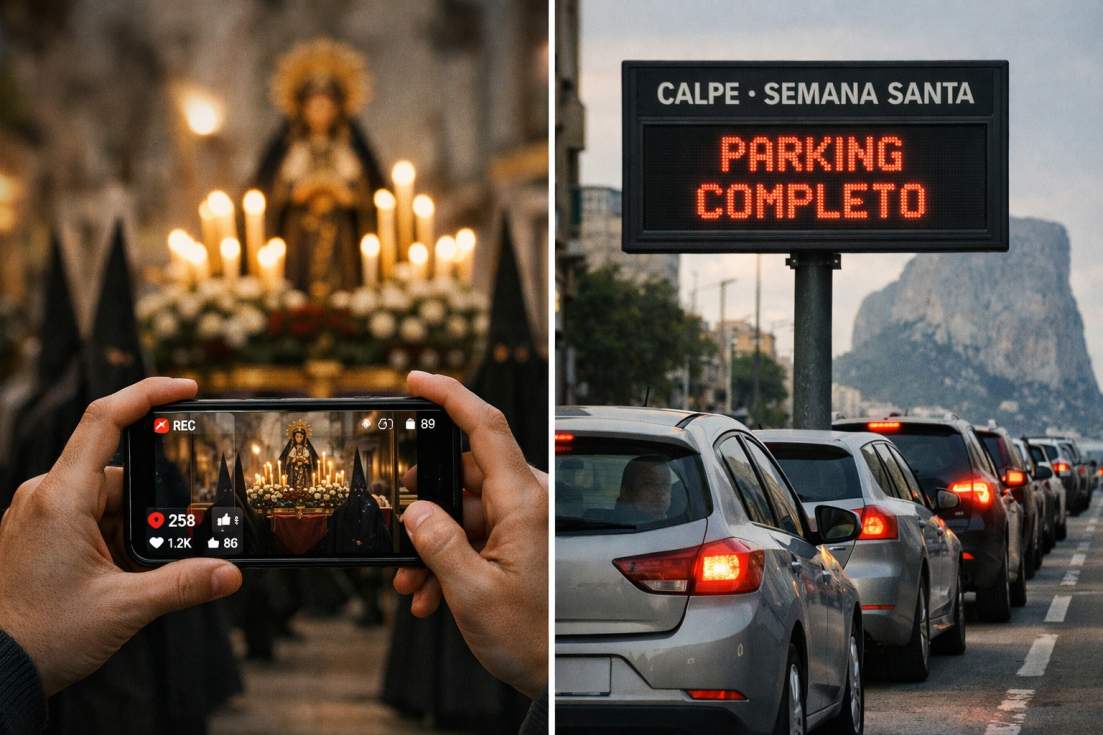
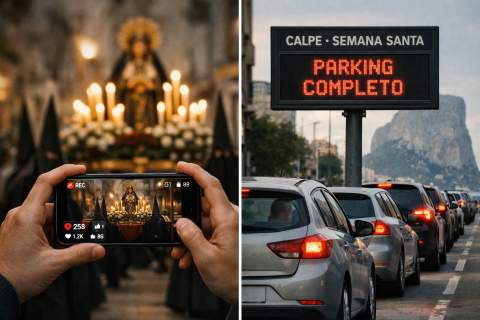
you cannot park.
The pavements are invaded.
Cars pile up.
The local resident drives in circles.
And the feeling begins to be the same as always:
that the calpino endures… what others merely occupy.
There, once again, the parallel reality appears.
On the one hand, the people honour a tradition they feel is theirs.
On the other, the calpino begins to live in his own town under strain.
Because when Holy Week arrives and it is already hard to park, already hard to pass through, already hard to move around, the question stops being a small one.
The question becomes severe:
if Calp is already like this in April,
what is left for August?
Because a town is not measured only by how well it celebrates.
It is measured by whether those who live in it can go on inhabiting it without feeling pushed out by endless circling, saturation and resignation.
This is not only a problem of cars.
It is a symptom of a model.
Of a town that knows how to draw people in,
but not how to order itself.
That knows how to fill up,
but not how to protect those who sustain it all year long.
And when that happens, the local resident begins to notice an uncomfortable truth:
the visitor parks however he can.
The calpino lives however he is allowed.
Neighbor,
there are things that are not used.
They are honoured.
And a people are honoured wholly,
not only from time to time.
They are honoured in the procession, yes.
But also when the music ends
and the local resident does not have to fight for his own place among cars, detours and saturation.
Because that is where the test lies.
Not in the photograph.
Not in the greeting.
Not in ceremonial presence.
The test lies in whether the calpino can live in his own town
or only endure it when the great days arrive.
If in April it is already hard to park,
if pavements are already being invaded,
if the town is already tightening until it feels borrowed,
then August is not a hypothesis.
It is an announced threat.
And when the people go on honouring what is theirs
while power manages the scene,
the scene no longer deceives.
It only gives itself away.
Once read,
it cannot be unread.

AVE CALPINVS.
Francisco Ramón Perona García (@fran_rpg)
Jurist. Citizen. Uncomfortable.

Neighbor,
there are things in a town that do not depend on power.
They are not born in an office.
They are not scheduled by a council department.
They are not sustained by a press release.
Nor by an official in the front row.
They remain alive for another reason.
Because a people do not put them on display: they carry them within.
Calp’s Holy Week is not upheld by those who arrive when everything is already prepared.
It is upheld by those who are there beforehand.
Those who carry.
Those who rehearse.
Those who sew.
Those who accompany.
Those who keep silent.
Those who repeat an inherited gesture without turning it into a showcase.
That is why, this week, it is worth beginning where power almost never begins:
not with the photograph,
not with the representation,
not with ceremonial presence,
but with truth.
And the truth is this:
popular faith does not need spotlights.
Tradition does not need posing.
And a people can tell at once who sustains what is theirs… and who merely passes through it.
Because it is one thing to honour a tradition.
It is another to use it.
It is one thing to stand with the people.
It is another to be seen among them.
Nor is that anything new, Neighbor.
It was already warned centuries ago:
when prayer seeks to be seen, it ceases to speak of faith… and begins to speak of appearance.
That is where the line lies.
Not between believers and non-believers.
Not between tradition and modernity.
The line lies between what is lived… and what is used.
Between the humble truth of the people
and the temptation to draw near to the sacred only when it looks good.
Because there are presences that are not born of respect.
They are born of calculation.
There are highly visible displays of devotion on the calendar.
And absences far too long throughout the rest of the year.
There is much solemnity when there are candles.
And far too much lightness when it comes time to govern what is serious:
housing,
waiting,
the neglect of the urbanizaciones,
security that cannot be felt,
the structure that can always be postponed just a little longer.
A procession does not correct bad priorities.
A photograph does not replace a plan.
When power has no project, it manages atmosphere.
That is why this column is not written to argue against Holy Week.
It is written to protect its truth.
Because when power draws near to a true tradition, it has two paths.
One: to respect it.
The other: to use it.
To use it is to turn the sacred into atmosphere.
Heritage into scenery.
The people’s faith into a backdrop in order to seem close to the people… without being there when life tightens its grip.
And so here appears the moral difference that matters.
The people honour.
Power poses.
The people remain.
Power shows up.
The people carry.
Power visits.
There are those who live a tradition.
And those who use it as a stage for proximity.
And this is not about denying anyone the right to be there.
It is about remembering something more serious:
being there does not always mean belonging.
appearing does not always mean sustaining.
Because after the incense, emotion is not all that remains.
The city remains.
And the city, even in these days of reflection, is already beginning to show its other face again:
you cannot park.
The pavements are invaded.
Cars pile up.
The local resident drives in circles.
And the feeling begins to be the same as always:
that the calpino endures… what others merely occupy.
There, once again, the parallel reality appears.
On the one hand, the people honour a tradition they feel is theirs.
On the other, the calpino begins to live in his own town under strain.
Because when Holy Week arrives and it is already hard to park, already hard to pass through, already hard to move around, the question stops being a small one.
The question becomes severe:
if Calp is already like this in April,
what is left for August?
Because a town is not measured only by how well it celebrates.
It is measured by whether those who live in it can go on inhabiting it without feeling pushed out by endless circling, saturation and resignation.
This is not only a problem of cars.
It is a symptom of a model.
Of a town that knows how to draw people in,
but not how to order itself.
That knows how to fill up,
but not how to protect those who sustain it all year long.
And when that happens, the local resident begins to notice an uncomfortable truth:
the visitor parks however he can.
The calpino lives however he is allowed.
Neighbor,
there are things that are not used.
They are honoured.
And a people are honoured wholly,
not only from time to time.
They are honoured in the procession, yes.
But also when the music ends
and the local resident does not have to fight for his own place among cars, detours and saturation.
Because that is where the test lies.
Not in the photograph.
Not in the greeting.
Not in ceremonial presence.
The test lies in whether the calpino can live in his own town
or only endure it when the great days arrive.
If in April it is already hard to park,
if pavements are already being invaded,
if the town is already tightening until it feels borrowed,
then August is not a hypothesis.
It is an announced threat.
And when the people go on honouring what is theirs
while power manages the scene,
the scene no longer deceives.
It only gives itself away.
Once read,
it cannot be unread.
AVE CALPINVS.
Francisco Ramón Perona García (@fran_rpg)
Jurist. Citizen. Uncomfortable.













Normas de participación
Esta es la opinión de los lectores, no la de este medio.
Nos reservamos el derecho a eliminar los comentarios inapropiados.
La participación implica que ha leído y acepta las Normas de Participación y Política de Privacidad
Normas de Participación
Política de privacidad
Por seguridad guardamos tu IP
216.73.216.176